 Soku AI
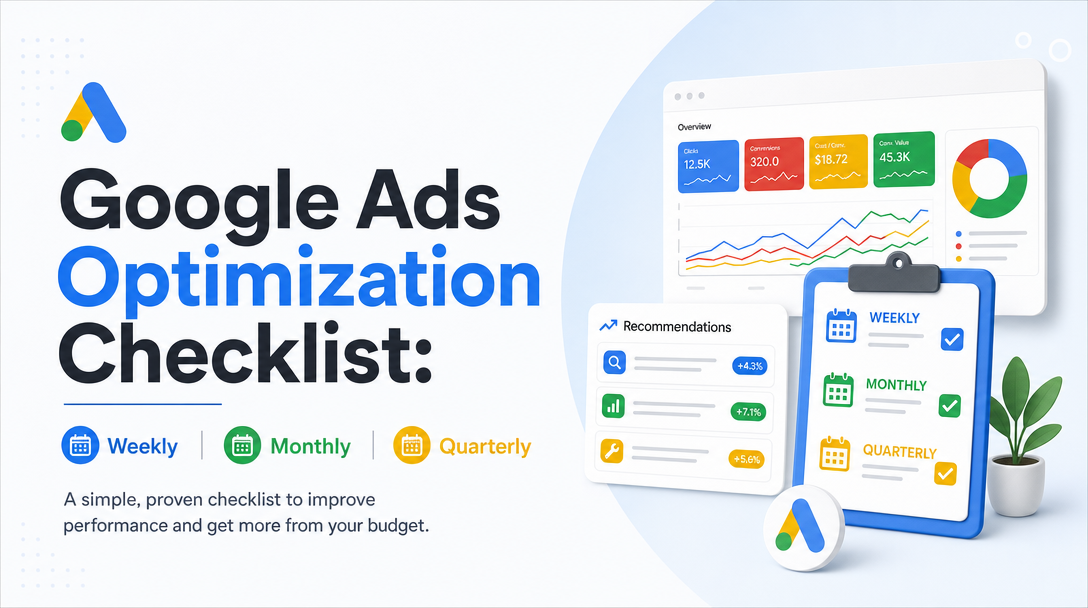
Most Google Ads checklists are audits in disguise. They tell you to "review search terms" and "check your bid strategy," which is advice you already had. What they leave out is the part that decides whether the checklist is worth running: what you do with what you find.
A check without a decision rule is an observation. Observations accumulate. Accounts get worse anyway.
So this checklist is built the other way round. Each item has a trigger — a condition you can actually evaluate — and an action you take when the trigger fires. If the trigger does not fire, you move on, and the whole weekly pass takes twenty minutes rather than two hours.
It is also explicitly a cadence, not a one-time audit. A one-time audit is what you run when you inherit an account. This is what you run for the next two years.
Why cadence, not audit
The frequency of a check should match the frequency at which the underlying thing can change. That sounds obvious and is almost universally violated.
Search terms accumulate daily, so they need weekly attention. Account structure changes only when the business changes, so auditing it weekly is theatre. Creative fatigue develops over weeks. Bid strategy learning periods run one to two weeks, so judging a bid strategy weekly means judging it during the period when it is explicitly not representative.
Put the wrong check on the wrong cadence and you get the two classic failure modes: thrashing (changing bid strategies every week and permanently living in the learning period) and drift (discovering in month nine that the account structure stopped matching the business in month two).
Weekly — 20 minutes
The weekly pass exists to catch things that are bleeding money now.
1. Budget pacing
Trigger: month-to-date spend is more than 10% off the straight-line pace toward the monthly target.
Action: if under, check whether it is a budget cap or an impression-share-to-rank problem — those need opposite responses. If over, check for a recently loosened target or a new campaign that is absorbing more than planned.
2. Search terms
Trigger: any term with spend and zero conversions above roughly one-third of your target cost per conversion.
Action: negative it at the right level. Ad group negative if it is a match-type leak; campaign negative if it is a theme you never want. Resist the urge to negative everything with zero conversions — low-spend zero-conversion terms are usually just small samples.
3. Lost impression share to budget
Trigger: above 10% on a campaign you want to scale.
Action: this is the single cheapest growth lever in most accounts, because it is demand you already qualified and simply declined to buy. Raise the budget or reallocate from a campaign losing share to rank.
4. Disapprovals and asset flags
Trigger: any disapproved ad, or any asset marked "Low" that is the only asset of its type.
Action: fix immediately. A disapproved ad in a single-ad ad group silently stops the ad group.
5. Conversion tracking heartbeat
Trigger: any primary conversion action recording zero conversions in the last 7 days when it normally records some.
Action: stop and check the tag before touching anything else. Every optimisation decision downstream of a broken conversion action is wrong, and automated bidding will actively make it worse.
That last one is the most valuable item on this entire page, and it is the one most commonly missing from checklists. Broken tracking does not look like an error. It looks like a performance collapse, and it invites exactly the wrong response.
Monthly — 2 hours
The monthly pass exists to catch trends that a week is too short to see.
6. Performance trend, brand split out
Trigger: non-brand cost per conversion up more than 15% month over month.
Action: decompose before acting. CPC up, or conversion rate down? CPC up points at the auction — check lost IS to rank and auction insights. Conversion rate down points at the landing page or the traffic mix. These have nothing to do with each other and the fix for one makes the other worse.
7. Bid strategy review
Trigger: a strategy has been live more than 30 days and is missing its target by more than 20%.
Action: adjust the target, do not switch the strategy. Switching restarts learning. Move targets in increments of 10–15%; larger jumps reset behaviour as effectively as a switch.
8. Creative refresh
Trigger: the best-performing RSA in an ad group is more than 90 days old, or asset performance labels have gone stale.
Action: add new assets rather than replacing wholesale, so you keep the winners and give the system new material to combine.
9. Landing page check
Trigger: conversion rate down on stable traffic, or Core Web Vitals regressions on the pages taking the most spend.
Action: landing pages usually degrade through accumulation — a new banner, another script, a consent layer. Check what shipped.
10. Competitor and auction insights
Trigger: a new entrant above 10% impression share on your core terms.
Action: this is context for interpreting your own numbers, not an instruction to bid harder. Rising CPCs with a new well-funded entrant is a market fact; bidding into it without a margin check is how accounts lose money profitably-looking.
11. Performance Max composition
Trigger: PMax spend growing while total account conversions are flat.
Action: check whether PMax is absorbing conversions that Search was already getting. Brand exclusions and a genuine incrementality read matter more here than any asset tweak.
Quarterly — half a day
The quarterly pass exists to catch the things that are structurally wrong rather than tactically off.
12. Account structure versus the business
Trigger: the products, services or margins the business actually cares about no longer map cleanly onto campaigns.
Action: restructure. This is the highest-leverage and most-deferred task in Google Ads, because nothing breaks visibly when structure drifts — the account simply becomes progressively harder to steer.
13. Budget reallocation across campaigns
Trigger: any campaign whose marginal return is clearly below another's.
Action: move budget toward the campaign with headroom (high lost IS to budget, on-target efficiency). Most accounts are meaningfully mis-allocated because budgets are set once and inherited forever.
14. Conversion action inventory
Trigger: more than one primary conversion action, or any primary action whose business value has changed.
Action: confirm what is primary, what feeds bidding, and what the values are. Conversion value accuracy is the input to every value-based bid strategy, and it is usually set once and never revisited.
15. Negative keyword hygiene
Trigger: any shared negative list older than a quarter.
Action: audit for over-blocking. Aggressive negativing accumulates and eventually starts excluding traffic you now want, particularly after the business adds products.
16. Testing calendar
Trigger: no structured test ran last quarter.
Action: plan one. Not "test new ad copy" — a specific hypothesis, a defined success metric, and enough volume to read it.
The decision rules that matter most
Three rules do more work than the rest of the list combined.
Change one thing at a time, and give it a learning period. Google's automated bidding needs one to two weeks to stabilise after a material change. Stack three changes in a week and you have learned nothing about any of them — you have just paid for the learning period three times.
Do not optimise into a broken measurement. Every item above assumes conversion tracking is correct. When it is not, automated bidding will faithfully optimise toward the wrong signal, and it will do so quickly and at scale. Check the heartbeat first.
Distinguish the auction from the account. Rising CPCs, falling impression share to rank and new entrants in auction insights are market conditions. They call for a margin decision, possibly a strategic one, but they are not evidence that the account is badly managed — and treating them that way produces a lot of pointless activity.
Where this cadence breaks down
The honest limitation of any checklist is that it runs on a human schedule while the account runs continuously.
The weekly items above are the ones with the highest cost of delay, and they are weekly for exactly one reason: a person has to sit down and do them. A budget that starts overpacing on Tuesday is discovered on Monday. A conversion action that breaks on Wednesday night is discovered on Monday, after five days of automated bidding optimising toward a signal that is not there.
None of the weekly checks are hard. Every one of them is a threshold on data the API already exposes. That is the shape of work that should not be on a human calendar at all — and it is what Soku does as an ads agent: run the weekly triggers continuously, surface only the ones that fired, and leave the monthly and quarterly judgement calls to the person who actually owns the account.
That is the right division of labour. The weekly pass is threshold-checking, which machines are better at. The quarterly pass is deciding whether the account still matches the business, which they are not.
Where to go next
- Free Google Ads reporting template — the reporting structure that pairs with this cadence
- Google Ads management software — the tooling landscape, with real prices where vendors publish them
Frequently asked questions
How often should I optimize Google Ads?
Match each check to how fast the underlying thing changes. Search terms, budget pacing and disapprovals weekly; performance trends, bid targets and creative monthly; account structure, budget allocation and conversion setup quarterly. Optimising everything weekly causes thrashing and keeps automated bidding permanently in a learning period.
What should I check in Google Ads every week?
Budget pacing against the monthly target, new search terms with spend and no conversions, lost impression share to budget on campaigns you want to scale, any disapprovals or single-asset flags, and a conversion-tracking heartbeat. The last of these is the most important, because every other decision depends on it.
Is a Google Ads optimization checklist the same as an audit?
No. An audit is a one-time deep assessment, usually when inheriting an account or diagnosing a problem. A checklist is a recurring operating cadence you run indefinitely. The audit tells you where you are; the cadence keeps you there.
How long should I wait before judging a bid strategy change?
At least one to two weeks, because automated bidding re-enters a learning period after material changes. Judging inside that window measures the learning period rather than the strategy. When a strategy misses its target after 30 days, adjust the target by 10–15% rather than switching strategies.
Why did my Google Ads performance drop suddenly?
Check conversion tracking before anything else — a broken primary conversion action looks exactly like a performance collapse. After that, decompose into CPC and conversion rate: rising CPC points at auction pressure, falling conversion rate points at the landing page or traffic mix.